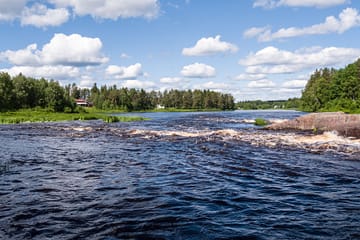
Have you ever stopped to think about how many emotions water can awaken? Swimming skills don’t grow from technique alone. They grow from what the mind and body experience in the water. Sometimes simply floating is enough, especially when life feels heavy or the mind is stressed. Sometimes cold water makes the body tense up before you even have time to think. And sometimes stepping into the water feels so frightening that you don’t want to go in alone.
Ensiaskeleet veteen
Recently, I worked with a client who had an immigrant background and was visiting a swimming hall for the first time in her life. Imagine how that feels. The Finnish washing and swimming culture was completely new to her. Everything around her was unfamiliar: the routines, the rules, the environment. And when she finally stepped into the pool, the water felt cold, and the pool looked deep. The tension rose so quickly that it made her dizzy.
But then someone meets you where you are. Speaks calmly. Walks beside you in the shallow end, one step at a time. And slowly the body begins to soften, the breath settles, and the water doesn’t feel quite as foreign anymore.
After walking together for a while, I let her move on her own in the shallow end. No rush, no goals. Just the feeling of her feet on the bottom and giving her body time to adjust to this new sensation. She paused now and then, took a deep breath, and quietly said that the tension was starting to ease. A small change, but an important one.
I reminded her about breathing, how a slow exhale is like a message to the body: you are safe. The water doesn’t demand anything. It simply holds you.
Practices are always individual
Every swimmer needs something different. For some, floating on the back feels easiest because the face stays dry and breathing is simple. For others, starting on the stomach feels safer because you can see the surroundings and clearly understand how deep the water is. This time, floating on the back felt like too big a step. So we took a pool noodle and explored whether she could lean on it even a little.
It was difficult. Her body didn’t yet trust that anything other than her own feet could support her. So we changed the approach. We lifted her feet gently, one at a time, just enough for her to feel the buoyancy. Then we tried a seated position, leaning on the noodle like a soft armchair, feet still grounded. A small, playful moment, but it brought a new kind of softness into her body.
Still, I felt that back‑floating wasn’t the right direction for her just then. I sensed she might find it easier to continue on her stomach. So we brought another group member along and did small breathing exercises. First, we dipped only the mouth. Then the nose. Then the whole face. And suddenly the tension was gone. She laughed and said that looking underwater felt surprisingly good.
Finally, we walked together while she blew bubbles into the water and dipped her face now and then. No pressure, no pushing. Just curiosity and joy. For the first time in her life, she put her face in the water and went home feeling like a winner.
What does this tell us about swimming?
Watching moments like this, I always notice the same thing: swimming doesn’t begin with the arms or legs. It begins with a feeling. With what the body tells you when it meets the water. Every new swimmer brings their own history, their own experiences, and their own nervous system’s way of reacting. That’s why there is no single right way to start. There is only what feels safe in that moment.
Water reveals a lot. It shows where the body tenses, where the breath stops, and where the mind still tries to hold on to control. And at the same time, water offers a possibility. When the body gets time, when the breath softens, and when someone walks beside you, the water begins to feel different. It no longer pushes you away. It begins to hold you.
This is the heart of swimming. Not how far you swim or how quickly you learn, but the moment when the body and mind find a shared rhythm. When water is no longer a threat, but a place where you can be at ease.
What does water feel like to you?
Water awakens something in all of us. For some, it is calm. For others, tension. For some, it brings childhood memories, for others, it is a completely new world. No feeling is wrong, and no feeling tells whether you can swim or not. It only tells what your relationship with water is right now.
Maybe you’ve felt that small tension when the water feels cold. Or the relief when your breath settles. Or the joy of dipping your face and realizing it wasn’t as scary as you thought.
Water is a place where you can learn to listen to yourself. It doesn’t require performance. It doesn’t require courage all at once. It allows you to move forward at the pace that feels right for you.
If you want to explore your own relationship with water, I’m happy to walk beside you. Not pushing, but listening. Not rushing, but letting the water tell you how it feels to you.
Do you want to know more about our upcoming courses? Join our newsletter.